Author: Jones Palitz Industrial Team

Quarterly Report Q1 2026

The Inland Empire industrial market is clearly in a cooling phase after a long stretch of rapid expansion. Vacancy is rising across the region, and a big part of that shift is coming from tenants giving space back rather than new construction flooding the market. Several very large buildings have gone empty at the same time, which has amplified the overall impact and made the slowdown feel more pronounced. Instead of aggressive growth, the market now feels like it is resetting and finding a more balanced footing after the highs of the past few years.

Leasing activity is still happening at a healthy pace, which shows there is still demand in the market, but the nature of that demand has changed. Many companies are being more cautious, often downsizing, consolidating, or taking time before making long-term commitments. Even though deals are getting done, they are not enough to fully offset the amount of space being returned. This dynamic is shifting leverage toward tenants, giving them more negotiating power, more options, and generally better deal terms than they have had in recent years.
Quarterly Report Q4 2025

The Inland Empire industrial market concluded the fourth quarter of 2025 exhibiting clear signs of normalization following several years of accelerated growth and historically tight conditions. Overall vacancy increased modestly on a quarter over quarter basis as newly delivered inventory outpaced leasing activity and tenant decision making slowed. Despite this softening, the region remains one of the most active industrial markets in the United States, supported by its scale, infrastructure, and proximity to the Ports of Los Angeles and Long Beach. Market conditions are increasingly reflective of a shift toward equilibrium rather than contraction.

Leasing activity moderated during the quarter, with gross leasing volume declining from earlier periods and year-over-year levels. Net absorption turned slightly negative in Q4 2025 although the East was stronger then West, as tenant move outs and space consolidations offset new leasing transactions. Demand, however, remained present, particularly among logistics, e-commerce, and third-party distribution users seeking modern, high-clear warehouse facilities. Transaction activity continued to favor larger blocks of space, indicating that occupiers are prioritizing operational efficiency and long-term strategic positioning over rapid expansion.

Quarterly Report Q3 2025

The Inland Empire industrial market concluded the fourth quarter of 2025 exhibiting clear signs of normalization following several years of accelerated growth and historically tight conditions. Overall vacancy increased modestly on a quarter over quarter basis as newly delivered inventory outpaced leasing activity and tenant decision making slowed. Despite this softening, the region remains one of the most active industrial markets in the United States, supported by its scale, infrastructure, and proximity to the Ports of Los Angeles and Long Beach. Market conditions are increasingly reflective of a shift toward equilibrium rather than contraction.

Leasing activity moderated during the quarter, with gross leasing volume declining from earlier periods and year-over-year levels. Net absorption turned slightly negative in Q4 2025 although the East was stronger than West, as tenant move outs and space consolidations offset new leasing transactions. Demand, however, remained present, particularly among logistics, e-commerce, and third-party distribution users seeking modern, high-clear warehouse facilities. Transaction activity continued to favor larger blocks of space, indicating that occupiers are prioritizing operational efficiency and long-term strategic positioning over rapid expansion.

Quarterly Report Q2 2025

The Inland Empire industrial market concluded the fourth quarter of 2025 exhibiting clear signs of normalization following several years of accelerated growth and historically tight conditions. Overall vacancy increased modestly on a quarter over quarter basis as newly delivered inventory outpaced leasing activity and tenant decision making slowed. Despite this softening, the region remains one of the most active industrial markets in the United States, supported by its scale, infrastructure, and proximity to the Ports of Los Angeles and Long Beach. Market conditions are increasingly reflective of a shift toward equilibrium rather than contraction.

Leasing activity moderated during the quarter, with gross leasing volume declining from earlier periods and year-over-year levels. Net absorption turned slightly negative in Q4 2025 although the East was stronger than West, as tenant move outs and space consolidations offset new leasing transactions. Demand, however, remained present, particularly among logistics, e-commerce, and third-party distribution users seeking modern, high-clear warehouse facilities. Transaction activity continued to favor larger blocks of space, indicating that occupiers are prioritizing operational efficiency and long-term strategic positioning over rapid expansion.

Quarterly Report Q1 2025

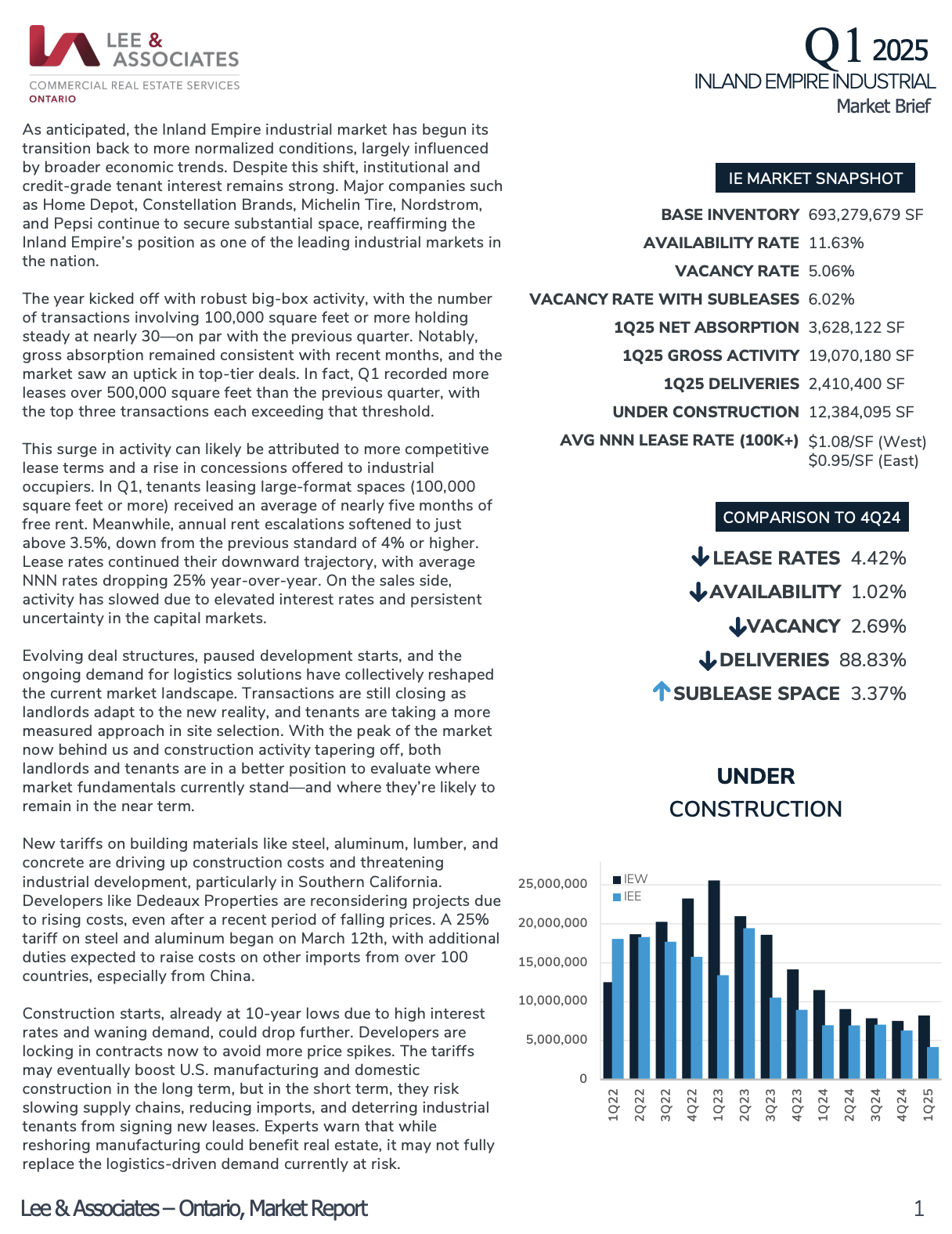
As anticipated, the Inland Empire industrial market has begun its transition back to more normalized conditions, largely influenced by broader economic trends. Despite this shift, institutional and credit-grade tenant interest remains strong. Major companies such as Home Depot, Constellation Brands, Michelin Tire, Nordstrom, and Pepsi continue to secure substantial space, reaffirming the Inland Empire’s position as one of the leading industrial markets in the nation.

The year kicked off with robust big-box activity, with the number of transactions involving 100,000 square feet or more holding steady at nearly 30—on par with the previous quarter. Notably, gross absorption remained consistent with recent months, and the market saw an uptick in top-tier deals. In fact, Q1 recorded more leases over 500,000 square feet than the previous quarter, with the top three transactions each exceeding that threshold.

Quarterly Report Q4 2024

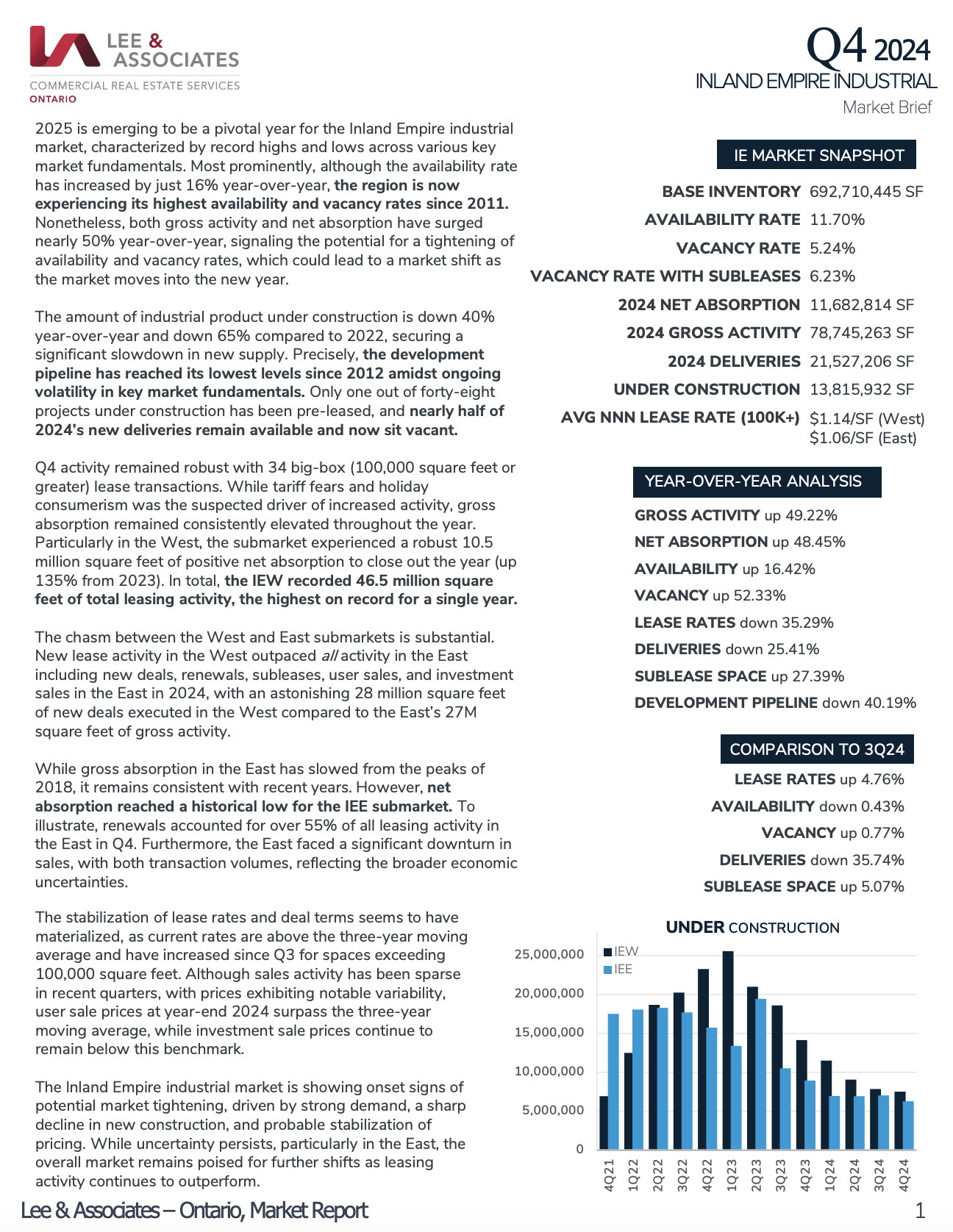
2025 is emerging to be a pivotal year for the Inland Empire industrial market, characterized by record highs and lows across various key market fundamentals. Most prominently, although the availability rate has increased by just 16% year-over-year, the region is now experiencing its highest availability and vacancy rates since 2011. Nonetheless, both gross activity and net absorption have surged nearly 50% year-over-year, signaling the potential for a tightening of availability and vacancy rates, which could lead to a market shift as the market moves into the new year.

The amount of industrial product under construction is down 40% year-over-year and down 65% compared to 2022, securing a significant slowdown in new supply. Precisely, the development pipeline has reached its lowest levels since 2012 amidst ongoing volatility in key market fundamentals. Only one out of forty-eight projects under construction has been pre-leased, and nearly half of 2024’s new deliveries remain available and now sit vacant.

Quarterly Report Q3 2024

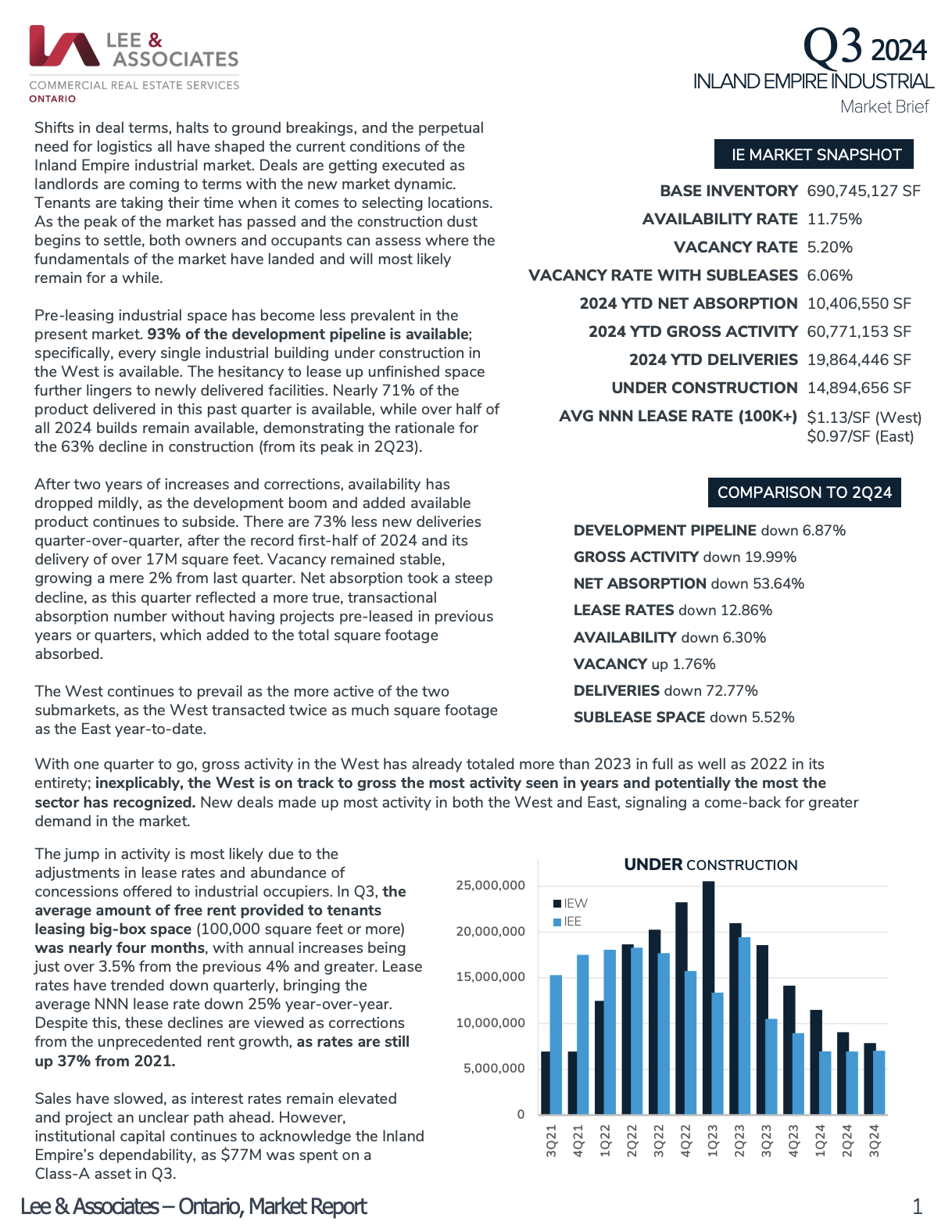
Shifts in deal terms, halts to ground breakings, and the perpetual need for logistics all have shaped the current conditions of the Inland Empire industrial market. Deals are getting executed as landlords are coming to terms with the new market dynamic. Tenants are taking their time when it comes to selecting locations. As the peak of the market has passed and the construction dust begins to settle, both owners and occupants can assess where the fundamentals of the market have landed and will most likely remain for a while.

Pre-leasing industrial space has become less prevalent in the present market. 93% of the development pipeline is available; specifically, every single industrial building under construction in the West is available. The hesitancy to lease up unfinished space further lingers to newly delivered facilities. Nearly 71% of the product delivered in this past quarter is available, while over half of all 2024 builds remain available, demonstrating the rationale for the 63% decline in construction (from its peak in 2Q23).

Quarterly Report Q2 2024

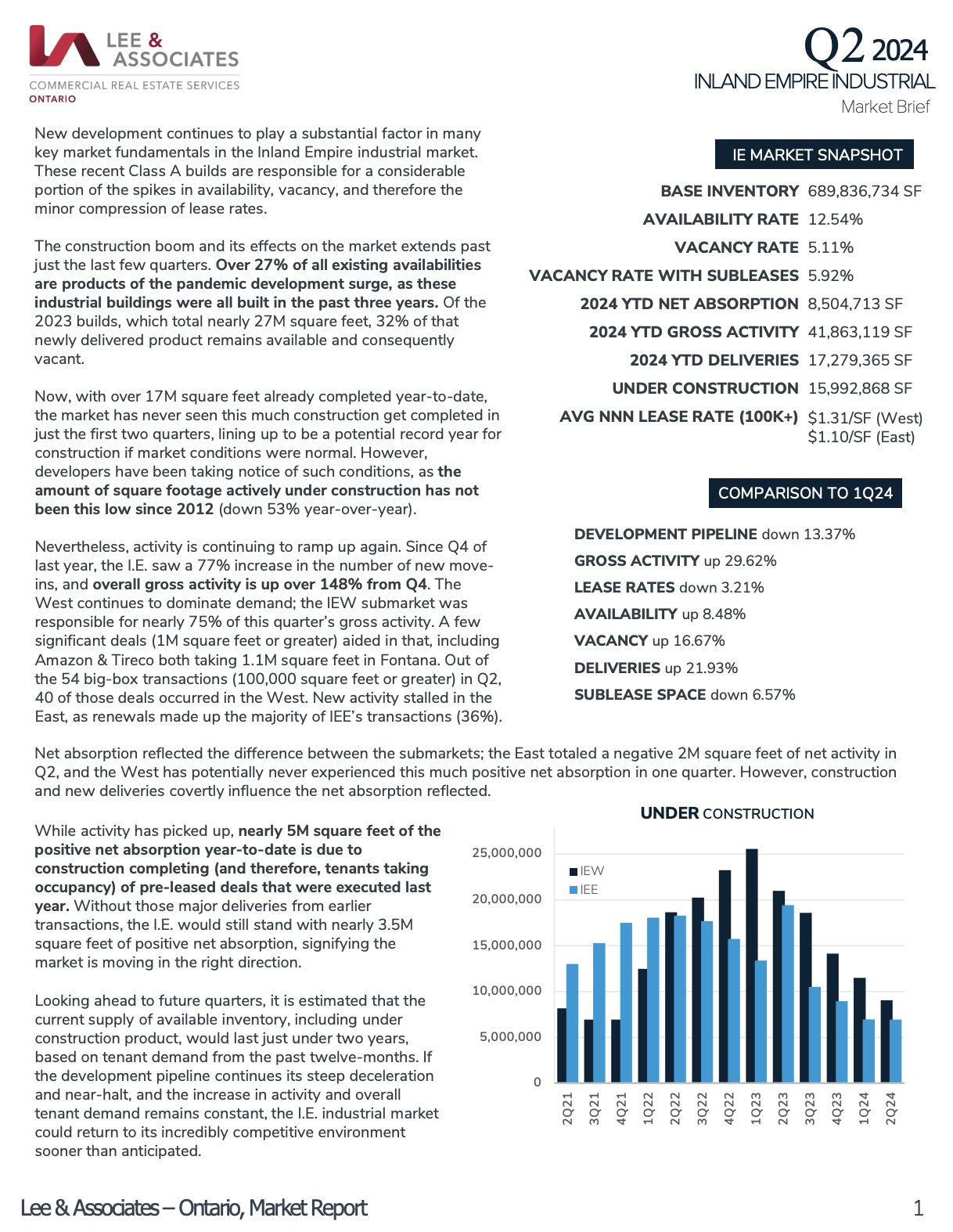
New development continues to play a substantial factor in many key market fundamentals in the Inland Empire industrial market. These recent Class A builds are responsible for a considerable portion of the spikes in availability, vacancy, and therefore the minor compression of lease rates.

The construction boom and its effects on the market extends past just the last few quarters. Over 27% of all existing availabilities are products of the pandemic development surge, as these industrial buildings were all built in the past three years. Of the 2023 builds, which total nearly 27M square feet, 32% of that newly delivered product remains available and consequently vacant.

Quarterly Report Q1 2024

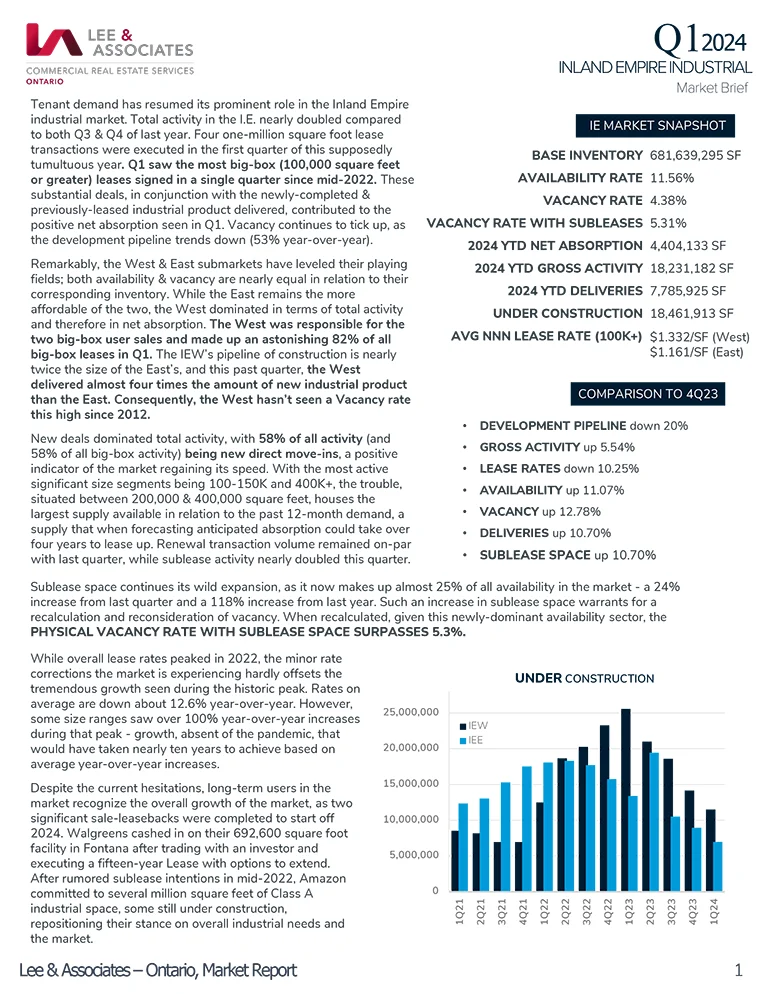
Tenant demand has resumed its prominent role in the Inland Empire industrial market. Total activity in the I.E. nearly doubled compared to both Q3 & Q4 of last year. Four one-million square foot lease transactions were executed in the first quarter of this supposedly tumultuous year. Q1 saw the most big-box (100,000 square feet or greater) leases signed in a single quarter since mid-2022. These substantial deals, in conjunction with the newly-completed & previously-leased industrial product delivered, contributed to the positive net absorption seen in Q1. Vacancy continues to tick up, as the development pipeline trends down (53% year-over-year).

Remarkably, the West & East submarkets have leveled their playing fields; both availability & vacancy are nearly equal in relation to their corresponding inventory. While the East remains the more affordable of the two, the West dominated in terms of total activity and therefore in net absorption. The West was responsible for the two big-box user sales and made up an astonishing 82% of all big-box leases in Q1. The IEW’s pipeline of construction is nearly twice the size of the East’s, and this past quarter, the West delivered almost four times the amount of new industrial product than the East. Consequently, the West hasn’t seen a Vacancy rate this high since 2012.

Quarterly Report Q4 2023

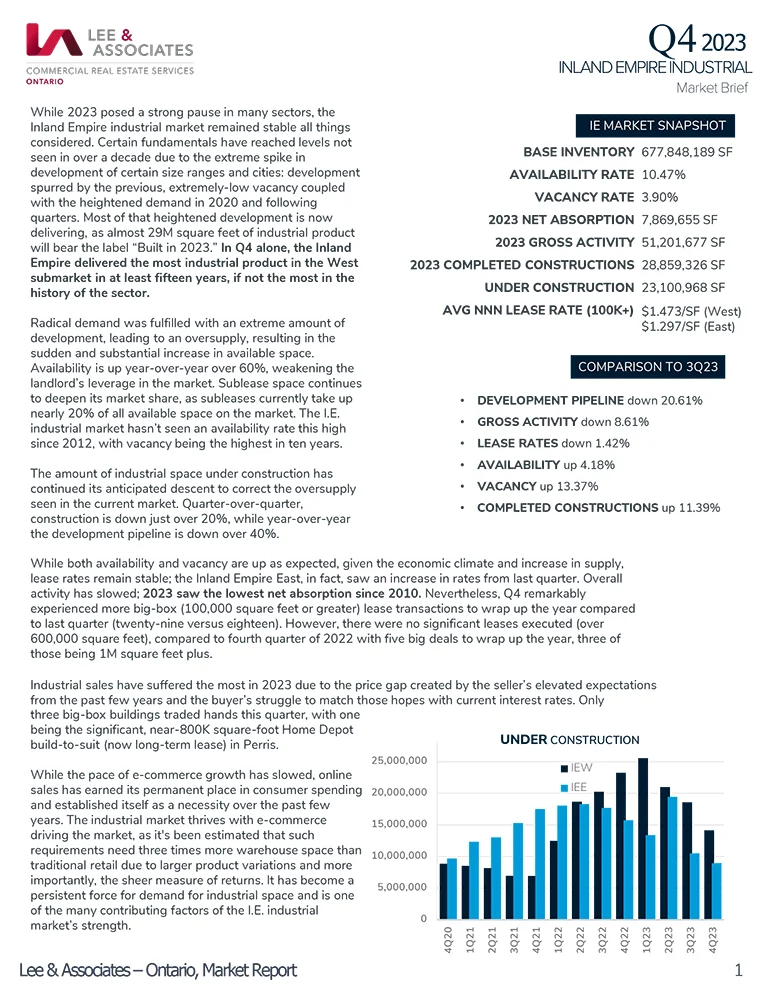
While 2023 posed a strong pause in many sectors, the Inland Empire industrial market remained stable all things considered. Certain fundamentals have reached levels not seen in over a decade due to the extreme spike in development of certain size ranges and cities: development spurred by the previous, extremely-low vacancy coupled with the heightened demand in 2020 and following quarters. Most of that heightened development is now delivering, as almost 29M square feet of industrial product will bear the label “Built in 2023.” In Q4 alone, the Inland Empire delivered the most industrial product in the West submarket in at least fifteen years, if not the most in the history of the sector.

Radical demand was fulfilled with an extreme amount of development, leading to an oversupply, resulting in the sudden and substantial increase in available space. Availability is up year-over-year over 60%, weakening the landlord’s leverage in the market. Sublease space continues to deepen its market share, as subleases currently take up nearly 20% of all available space on the market. The I.E. industrial market hasn’t seen an availability rate this high since 2012, with vacancy being the highest in ten years.